Closet Office (Cloffice) Setup: Measurements, Desk Options and Layouts
Disclosure: SnugSetup earns commissions when you buy through links on this page, at no extra cost to you. We earn commissions from Autonomous through an affiliate network. As an Amazon Associate I earn from qualifying purchases. Read our full disclosure.
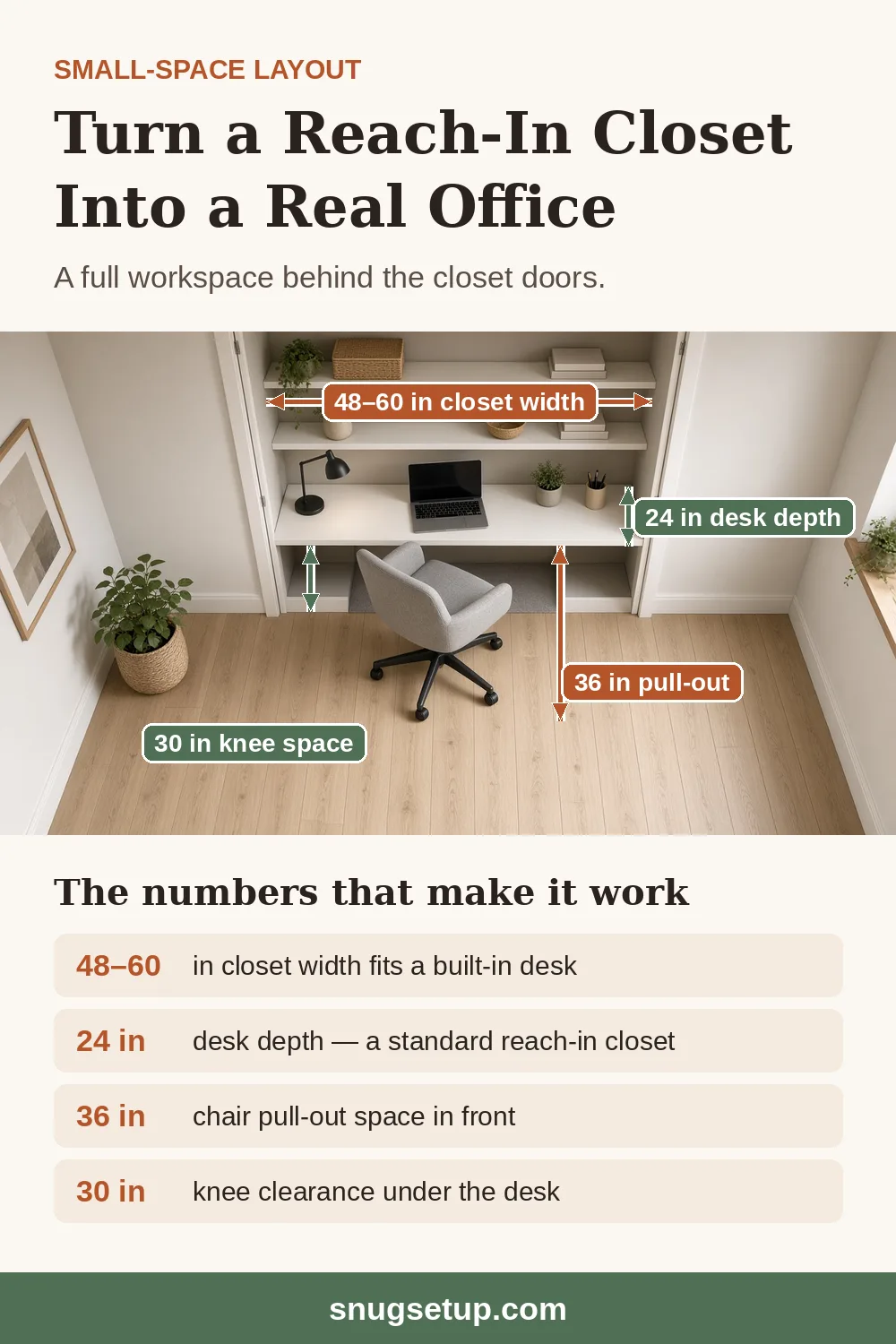
A closet office, or "cloffice", puts a full workspace behind a door you can close at the end of the day. A standard reach-in closet is about 24 inches deep, which happens to be the depth of many compact desks, and the shelves above become storage you'd otherwise have to find room for. If you're working with a corner of a room instead, see how to set up a small home office.
The catch is that a closet is a box with three walls. There's no room to push a desk back, often no outlet, little light and not much air. This guide covers the measurements to take before you buy anything, the desk types that suit closets of different widths, three layouts that work, and the small parts (monitor mounts, keyboard trays, lighting) that make a 2-foot-deep workspace comfortable. The product picks are compared on the dimensions, load ratings and mounting requirements their makers publish.

TL;DR: Our top picks
- Best for a 4-foot reach-in closet: VIVO Wall Mounted 43" x 18" Folding Workbench (Check current price). 43.3" x 18" top that folds to 2.3" from the wall, rated for 110 lbs; mounts to studs, brick or concrete.
- Best freestanding desk for a narrow closet: IKEA MICKE Desk, 28 3/4" x 19 5/8" ($69.99). Only 28 3/4" wide and 19 5/8" deep, so it fits a closet with a 30-inch opening, with no drilling.
- Best sit-stand desk for a wide or walk-in closet: Autonomous Desk Core ($349 at Autonomous's own store at the time of writing). 48" x 24" electric desk, 29.4" to 47.5" tall, if your closet is wide enough inside and has headroom above.
- Best monitor mount for a closet: VIVO Pneumatic Single Monitor Wall Mount (MOUNT-V001A) (Check current price). Wall-mounted gas-spring arm for 17"–32" screens, so the monitor sits on the closet wall instead of the desk.
- Best add-on for a shallow closet desk: VIVO Clamp-on Keyboard Tray, 27" (Check current price). Clamp-on tray adds a keyboard level under the desk and slides out 8.5", with no drilling.
Comparison table
| Product | Dimensions | Height, depth or adjustment | Weight capacity | Price |
|---|---|---|---|---|
| VIVO Wall Mounted 43" x 18" Folding Workbench | 43.3" x 18" top, 1" thick | 2.3" folded / 18" top depth open | 110 lbs | Check price on Amazon |
| IKEA MICKE Desk, 28 3/4" x 19 5/8" | 28 3/4" W x 19 5/8" D | Fixed, 29 1/2" (24 3/4" under the desk) | 110 lbs (drawer 7 lbs) | $69.99 as of Oct. 21, 2026 |
| Autonomous Desk Core | 48" x 24" top, 0.7" thick | 29.4" to 47.5" (with top) | 176 lbs | $349 as of Oct. 21, 2026 |
| VIVO Pneumatic Single Monitor Wall Mount (MOUNT-V001A) | 8.75" to 11.5" arm extension; 6.75" x 1.5" wall plate | 3" to 14.75" | 4.4 to 19.8 lbs | Check price on Amazon |
| VIVO Pneumatic Single Monitor Arm, 17"-27" (STAND-V101O) | 18.5" max extension; 3.75" x 4" base | 6" to 16.5" (center of screen) | 4.4 to 14.3 lbs | Check price on Amazon |
| VIVO Clamp-on Keyboard Tray, 27" | 26.8" x 11" tray (32.5" wide including clamps), 0.6" thick | 1.5" to 2.75" below the desktop | 11 lbs | Check price on Amazon |
Specs and prices come from each manufacturer's own product page or spec sheet, retrieved Oct. 21, 2026. Prices shown are the manufacturer's own store prices, not Amazon prices. Prices change often; the retailer's page is always the final word.
Size and fit, drawn to scale
Measure the closet first
Closets vary more than rooms do, so take these measurements with a tape measure before you choose a desk. Write them down; you'll compare each one against a product spec.
- Inside width, wall to wall. Measure the back wall and again at the front, just inside the door frame. The door opening is usually narrower than the closet itself because of the trim and short return walls on each side, and a desk has to pass through that opening (or be assembled inside).
- Inside depth. Measure from the back wall to the front of the door frame. Reach-in closets are commonly about 24 inches deep. A 24-inch desk then sits flush with the opening, and an 18- to 20-inch desk leaves a few inches behind it for cables.
- Height to the shelf or rod. Measure from the floor to the underside of the lowest shelf. You want room for a monitor above a roughly 29-inch desk, so a low shelf usually has to move up or come out.
- The clear floor in front. Your chair has to roll back out of the closet. Plan about 36 inches of clear floor in front of the opening; that's the space the pull-out zone in the photo above shows.
- Door type and swing. Bifold and sliding doors eat into the opening; hinged doors need room to swing open. Many cloffices take the doors off and use a curtain, or keep bifolds so the whole office disappears.
- Wall material and studs. Use a stud finder on the back and side walls. Every wall-mounted product here needs studs, brick or concrete, not drywall alone.
- The nearest outlet. Most closets don't have one. Note where the closest outlet is and whether a cord would have to cross a doorway.
The numbers that make a cloffice work
- Desk width: about 30 inches is the practical minimum for a laptop and a notebook; 40–48 inches fits a monitor, a lamp and a laptop side by side.
- Desk depth: 18–24 inches. On anything under about 20 inches, put the monitor on a wall mount or monitor arm so it isn't right in front of your face.
- Desk height: fixed desks are typically about 29–30 inches. A fold-down desk is whatever height you mount it at, so sit at a desk you like and measure it first.
- Knee space: leave the full width under the desk open, with no drawers or shelves at knee height, so you can sit square to the desk in a narrow space.
- Chair zone: about 36 inches in front of the closet to pull the chair out. In a walk-in closet that zone has to fit inside, which rules out many small walk-ins.
- Shelf above the desk: keep the first shelf high enough that the top of your monitor, on its mount, sits below it. If you want to stand, the shelf has to clear your standing eye level too.
Which kind of desk fits
Wall-mounted fold-down desk
Best for a standard 4- to 5-foot reach-in closet. The desk hangs on the back wall, so there are no legs to work around and the floor underneath stays clear for your feet. It folds flat when you close the closet. You need studs or masonry, and you'll mount it at one fixed height. See all the options in our wall-mounted desks guide.
Small freestanding desk
Best for renters and for narrow closets. A compact desk like the IKEA MICKE slides in with no drilling and slides out again when you move. Check that it fits through the door opening and that its legs leave room for your knees. Our desks for small spaces guide compares other compact desks.
Built-in desktop on cleats or brackets
A plank or countertop cut to the closet's width, resting on wall cleats or brackets, uses every inch of a wide closet. It's a DIY project rather than a product, so we haven't listed specs for it, but the same measurements apply.
Sit-stand desk
Possible in a wide reach-in or a walk-in, but closets add two checks: the frame's feet have to fit inside the closet's depth, and you need headroom for standing height under any shelf. Compare compact frames in our small standing desks guide.
Power, light and air
- Power: a flat-plug extension cord or power strip run along the baseboard is the usual workaround. Don't run cords under a rug or pinch them in a door. For a permanent setup, an electrician can add an outlet inside the closet.
- Light: closets are dark and overhead closet lights are often behind you, which puts your face in shadow on video calls. A clamp or wall lamp at the side of the desk, or a light bar on the monitor, works better than a single ceiling bulb. For calls, a small webcam light on the monitor lights your face from the front.
- Heat and air: a closed closet traps heat from a laptop, monitor and you. Leave the doors open while you work, or swap solid doors for a curtain.
- Cables: with the desk against the back wall, cables have nowhere to hide. Leave a few inches behind a shallow desk, or route cables down the side wall.
The picks, in detail
VIVO Wall Mounted 43" x 18" Folding Workbench
Who it's for: Laptop users with a standard reach-in closet at least about 44 inches wide inside, and studs, brick or concrete on the back wall.
VIVO sells the MOUNT-SF1FB as a folding workbench, but its size suits a closet desk well. VIVO lists a 43.3" x 18" top, 1 inch thick, on steel fold-down brackets. In a 24-inch-deep closet, the 18-inch top leaves about 6 inches behind it for cables, a power strip or a shelf lip, and when folded it sticks out only 2.3 inches, so it can close away with the closet doors.
VIVO rates it for 110 lbs and lists wood studs, brick or concrete as mounting surfaces; its manual says not to install into drywall alone. Because you choose the mounting height, it can sit at your preferred desk height. Plan your monitor separately: on an 18-inch top, a wall mount above the desk keeps the screen at a usable distance. Folding means clearing the desk first, so it suits a laptop-and-notebook setup best.
Pros
- 43.3" wide: fits a standard 4-foot reach-in
- Folds to 2.3" from the wall
- 110 lb rating
- No legs, so the floor stays clear
Cons
- Studs, brick or concrete required (not drywall alone)
- 18" deep: pair with a wall mount for a monitor
- Must be cleared before folding
- Sold as a workbench
Key specs
- Dimensions
- 43.3" x 18" top, 1" thick
- Height, depth or adjustment
- 2.3" folded / 18" top depth open
- Weight capacity
- 110 lbs
- Type
- Fold-down steel brackets; wood studs, brick or concrete (not drywall alone)
- Also
- Brackets 15.4" x 1.6" x 6.5"; sold as a workbench
- Model
- MOUNT-SF1FB (black; MOUNT-SF1FW in white)
Price: check current price. Spec source
Check price at Amazon (opens in a new tab)IKEA MICKE Desk, 28 3/4" x 19 5/8"
Who it's for: Renters, and anyone with a narrow closet (about 30 inches inside) who doesn’t want to drill.
MICKE is one of the smallest proper desks IKEA sells: 28 3/4 inches wide and 19 5/8 inches deep, at a fixed 29 1/2 inches tall, with a drawer and a 110 lb load rating. That width fits a narrow closet that a 40-inch desk wouldn't, and the depth leaves room behind it in a typical 24-inch closet.
The trade-off is knee room. IKEA lists 24 3/4 inches of clearance under the drawer, so check your chair's arm height against it, or choose an armless chair (see our compact office chairs). It was $69.99 on IKEA's site. If you need a wider freestanding desk for a bigger closet, compare the others in our desks for small spaces guide.
Pros
- 28 3/4" wide fits narrow closets
- No drilling; easy to move out
- Drawer for supplies
- 110 lb load rating
Cons
- 24 3/4" under the drawer: tight for chairs with arms
- Too narrow for a monitor plus a lamp side by side
- Fixed height
Key specs
- Dimensions
- 28 3/4" W x 19 5/8" D
- Height, depth or adjustment
- Fixed, 29 1/2" (24 3/4" under the desk)
- Weight capacity
- 110 lbs (drawer 7 lbs)
- Type
- Fixed height
- Also
- One drawer, 24 3/8" x 14 1/8" inside
- Model
- 302.130.76
Price at IKEA's own store at time of writing: $69.99 (as of Oct. 21, 2026). Spec source
Check price at IKEA (opens in a new tab)Autonomous Desk Core
Who it's for: People with a closet wider than about 4 feet inside who want to alternate sitting and standing.
The Desk Core is Autonomous's entry-level electric standing desk, with a 48" x 24" top and a height range of 29.4 to 47.5 inches including the top. Its 24-inch depth matches a standard reach-in closet, so it fills the closet front to back. Its 48-inch top needs a closet at least that wide inside, plus a little room for the frame to move freely, so measure wall to wall, not just the door opening.
Standing is where closets get tricky. Check that the lowest shelf clears your monitor at standing height, and that the motor's cable can reach an outlet. Autonomous lists a single motor, a 176 lb lifting capacity, a noise level of 50 dB or less and a 2-year warranty. For other frames, see our small standing desks guide.
Pros
- Electric sit-stand, 29.4"–47.5"
- 24" deep matches a standard reach-in closet
- 176 lb lifting capacity
- Free 30-day returns per the product page
Cons
- Needs about 4 ft of inside width
- Needs headroom under shelves when standing
- Needs an outlet in or near the closet
Key specs
- Dimensions
- 48" x 24" top, 0.7" thick
- Height, depth or adjustment
- 29.4" to 47.5" (with top)
- Weight capacity
- 176 lbs
- Type
- Electric, single motor
- Also
- Noise 50 dB or less; 2-year warranty; free 30-day returns (per product page)
- Model
- Desk Core
Price at Autonomous's own store at time of writing: $349 (as of Oct. 21, 2026). Spec source
Check price at Autonomous (opens in a new tab)VIVO Pneumatic Single Monitor Wall Mount (MOUNT-V001A)
Who it's for: Anyone putting a monitor on a shallow closet desk, especially a fold-down one.
In a closet, the back wall is the best place for your screen. VIVO's MOUNT-V001A is a gas-spring arm on a 6.75" x 1.5" wall plate that holds 17- to 32-inch screens weighing 4.4 to 19.8 lbs, with VESA 75 or 100 mounting. VIVO lists 8.75 to 11.5 inches of arm extension, which brings the screen forward off the wall toward you on a shallow desk.
Mounting the monitor on the wall also means a fold-down desk can still fold, since nothing sits on the desktop. It needs a stud or solid wall; VIVO includes anchors and screws. Mount it after the desk so you can set the height against your seated eye level.
Pros
- Frees the entire desktop
- Works with fold-down desks
- 17"–32" screens up to 19.8 lbs
- Gas spring height adjustment
Cons
- Needs a stud or solid wall
- Short reach (up to 11.5")
- Cable has to run down the wall
Key specs
- Dimensions
- 8.75" to 11.5" arm extension; 6.75" x 1.5" wall plate
- Height, depth or adjustment
- 3" to 14.75"
- Weight capacity
- 4.4 to 19.8 lbs
- Type
- Gas spring, wall mount
- Also
- 17"-32" screens; VESA 75/100; anchors and screws included
- Model
- MOUNT-V001A
Price: check current price. Spec source
Check price at Amazon (opens in a new tab)VIVO Pneumatic Single Monitor Arm, 17"-27" (STAND-V101O)
Who it's for: Renters who can’t drill the closet wall but have a freestanding desk 0.4 to 3.2 inches thick.
If you can't mount anything on the wall, a clamp-on arm does a similar job from the back edge of the desk. VIVO's STAND-V101O holds 17- to 27-inch screens weighing 4.4 to 14.3 lbs and reaches up to 18.5 inches forward, so on an 18- to 20-inch closet desk it can bring the screen out over the desk and leave the back free.
It clamps to desks 0.4 to 3.2 inches thick, or mounts through a grommet hole, and its 3.75" x 4" base takes very little space. It won't work on a fold-down desk that you need to fold with the arm attached. More options are in our monitor arms guide.
Pros
- No wall drilling
- 18.5" reach for shallow desks
- Small 3.75" x 4" base
Cons
- Up to 27" screens and 14.3 lbs
- Not for desks that must fold
- Needs a desk edge 0.4"–3.2" thick
Key specs
- Dimensions
- 18.5" max extension; 3.75" x 4" base
- Height, depth or adjustment
- 6" to 16.5" (center of screen)
- Weight capacity
- 4.4 to 14.3 lbs
- Type
- Gas spring, C-clamp or grommet
- Also
- 17"-27" screens; VESA 75/100; desk 0.4"-3.2" thick
- Model
- STAND-V101O
Price: check current price. Spec source
Check price at Amazon (opens in a new tab)VIVO Clamp-on Keyboard Tray, 27"
Who it's for: People on an 18- to 20-inch-deep closet desk who want the keyboard lower and farther from the screen.
A keyboard tray adds working depth without a deeper desk. VIVO's MOUNT-KB05E is a 26.8" x 11" tray that clamps to the underside of the desk, with no drilling, and VIVO lists it as sliding out 8.5 inches on a 12.3-inch track. It sits 1.5 to 2.75 inches below the desktop and is rated for 11 lbs.
Check two numbers before you buy. The clamps fit desks 0.5 to 1.25 inches thick, and the tray is 32.5 inches wide including its clamps, so it needs a desk at least that wide (it's too wide for the MICKE). It also stops a fold-down desk from folding. Other trays, including narrower ones, are in our keyboard trays guide.
Pros
- Clamps on, no drilling
- Slides out 8.5"
- Frees desktop for a laptop or notebook
Cons
- 32.5" wide including clamps: too wide for very small desks
- Desk must be 0.5"–1.25" thick
- Blocks a fold-down desk from folding
Key specs
- Dimensions
- 26.8" x 11" tray (32.5" wide including clamps), 0.6" thick
- Height, depth or adjustment
- 1.5" to 2.75" below the desktop
- Weight capacity
- 11 lbs
- Type
- C-clamps, no drilling; desks 0.5"–1.25" thick
- Also
- Slides out 8.5"; 12.3" track
- Model
- MOUNT-KB05E (black, 27")
Price: check current price. Spec source
Check price at Amazon (opens in a new tab)Three closet office layouts
1. The fold-away reach-in (4–5 ft wide, 24 in deep)
A fold-down desk across the back wall at seated height, a wall-mounted monitor above it, and the existing shelf raised to clear the screen. Everything closes away behind the doors at night. This is the layout for a bedroom closet you still need to share with clothes: keep one side's rod and hang the desk on the other, if the width allows.
2. The full-width built-in (5–8 ft wide)
A desk spanning the full closet, with open shelves above and a small filing cabinet or a drawer unit under one end. The extra width fits a monitor and a lamp side by side, as in the photo at the top of this guide. If you work from a laptop, a laptop stand raises the screen and frees space for an external keyboard.
3. The walk-in office
In a walk-in, the desk goes on the wall facing the door, and the chair has to fit inside. Small walk-ins of about 5 x 5 feet barely fit a 36-inch chair zone, so measure carefully. A compact or corner desk on the back wall leaves the side walls for shelving.
No closet to spare?
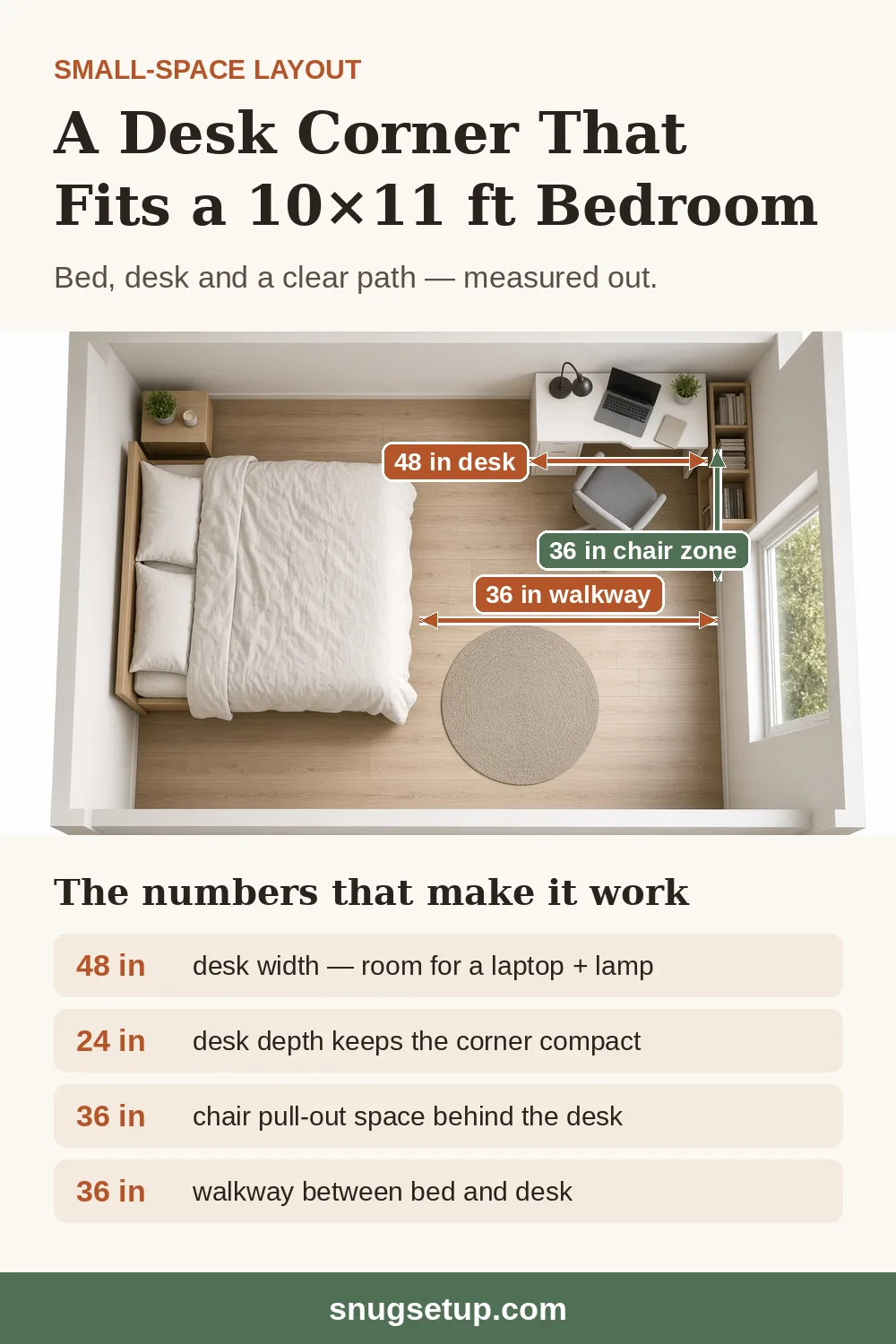
The same measurements work for a corner of a bedroom. The layout below fits a 48-inch desk, a 36-inch chair zone and a 36-inch walkway into a room of about 10 x 11 feet.

FAQ
How deep does a closet need to be for a desk?
A standard reach-in closet of about 24 inches deep fits a desk up to 24 inches deep, though an 18- to 20-inch desk leaves room behind it for cables. You also need about 36 inches of clear floor in front of the closet for your chair.
How wide does a closet need to be for an office?
About 30 inches inside fits a small desk like the 28 3/4-inch IKEA MICKE for a laptop. For a monitor and a lamp side by side, aim for 4 feet or more; the VIVO MOUNT-SF1FB is 43.3 inches wide and the Autonomous Desk Core is 48 inches.
Can I put a desk in a closet with doors?
Yes. Bifold and sliding doors let you close the office away, but they narrow the opening, and a closed closet traps heat. Many people remove the doors while working or replace them with a curtain.
How do I get power into a closet office?
Most closets don’t have an outlet. A flat-plug extension cord or power strip along the baseboard is the common workaround. For a permanent setup, have an electrician add an outlet.
Can I mount a desk in a closet if I rent?
Check your lease before drilling. A freestanding desk such as the IKEA MICKE and a clamp-on monitor arm need no holes in the wall.
Did you test these products?
No. We compared manufacturers’ published dimensions, load ratings and mounting requirements against common closet sizes. See How We Research for details.
About this guide
We picked desks and accessories whose makers publish the dimensions and mounting requirements needed to check closet fit, and compared them against common reach-in and walk-in closet sizes. Specs come from the manufacturers' product pages, retrieved on the dates shown in the comparison table, and each product links to its source. The room photos are illustrative layouts, not photos of the products. We didn't test these products hands-on and don't publish star ratings.
Written by the SnugSetup Editorial Team. Read how we research and our affiliate disclosure. Spotted an error? Email [email protected].